


Welcome to this edition of The Impact Post!
In an era where development is defined as much by technological evolution as it is by social equity, the impact sector is being forced to move beyond traditional checkboxes. From the high-stakes deployment of emerging tech in public systems to the intimate, everyday realities of healthcare access and professional burnout, this month’s edition explores how we can build more inclusive, rigorous, and accountable frameworks.
Our lead feature, “TCRM Matrix for AI in India’s Social Sector,” examines the critical gap in how we scale innovation, questioning whether commercial tech frameworks are truly equipped to handle the unique policy demands and beneficiary safeguards of India’s last mile. We follow this with a deep dive into the systems behind public welfare in “India’s Publicly Funded Health Financing & Where CSR Fits,” exploring how strategic corporate social responsibility can step in to fund the next generation of primary healthcare models where government programs stop short.
This edition also features a critical look at institutional equity in “Beyond the Mandate: Navigating Affirmative Action in CSR,” where we challenge corporate India to move past standard compliance checkboxes to build truly location-agnostic, systemic change for marginalized communities. In our practitioner spotlight, “NuSocia Case Study: KAP Methodology,” we share a masterclass in operational agility, showcasing how structured, reflective evaluation prompts can responsibly listen for early signals of impact even under extreme baseline data constraints.
We round out the issue with a powerful, introspective reflection, “The Cognitive Dissonance of the Social Impact Sector,” which pulls back the curtain on the quiet, heavy friction changemakers face when the structures they fight to dismantle by day are the very ones they must live within by night.
We hope these pieces challenge you to think not just about the work we do, but the underlying assumptions of how and why we do it.
Happy Reading!
TCRM Matrix for AI in India's Social Sector
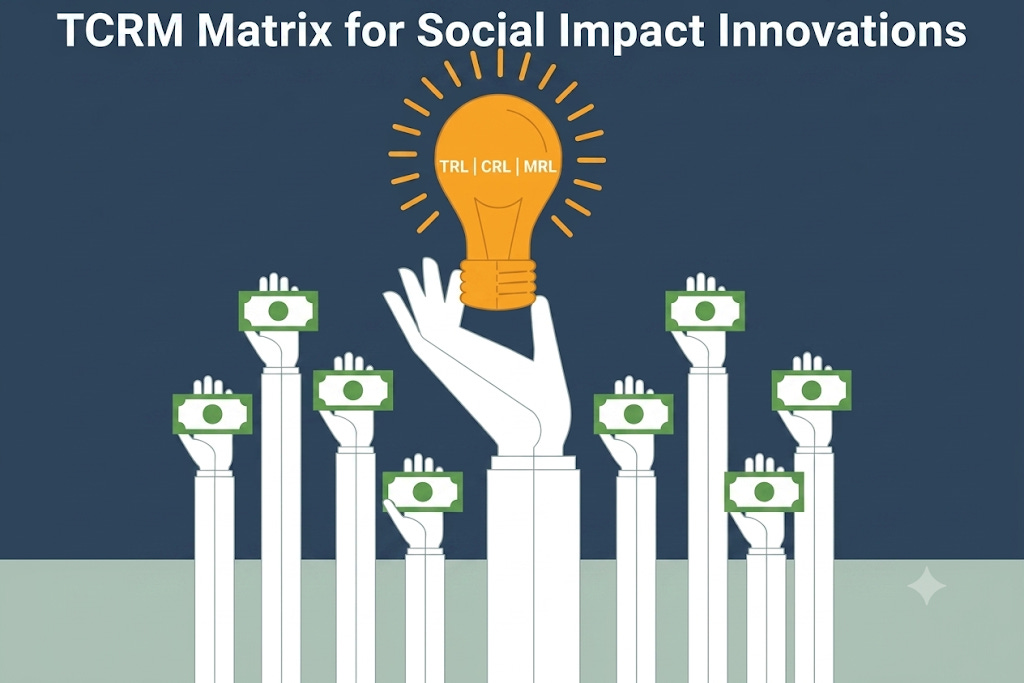
When a philanthropic funder or state department backs a flashy new digital public health pilot, how do they know if it is actually ready for India's last mile? While NITI Aayog's TCRM matrix works beautifully for commercial tech startups, it completely misses the policy alignment, state absorptive capacity, and beneficiary safeguards required for the social sector. Explore how this national framework is being rewritten to ensure high-stakes health tech applications don't stall on the road to scaling.

Beyond the Mandate: Navigating Affirmative Action in CSR
While India’s mandatory 2% CSR spending law was designed to boost corporate responsibility, it has inadvertently derailed targeted corporate affirmative action for Scheduled Caste and Scheduled Tribe communities. By substituting deep socio-economic equity initiatives with generic philanthropy, corporations are leaving massive blind spots around internal migrant workers and marginalized religious minorities. Read on to find out how corporate India can move past standard compliance checkboxes to build truly location-agnostic, systemic change.

A NuSocia Case Study: KAP Assessments
What do you do when you are commissioned to run an impact assessment but discover there is absolutely no baseline data or historical records to measure against? Instead of abandoning rigour or relying on uniform, "perfect" student answers, the NuSocia evaluation team adapted a classic methodology into an anonymous perception test. Learn how structured, reflective prompts can help practitioners responsibly listen for early signals of change even under extreme operational constraints.
India’s Publicly Funded Health Insurance & Where CSR Fits
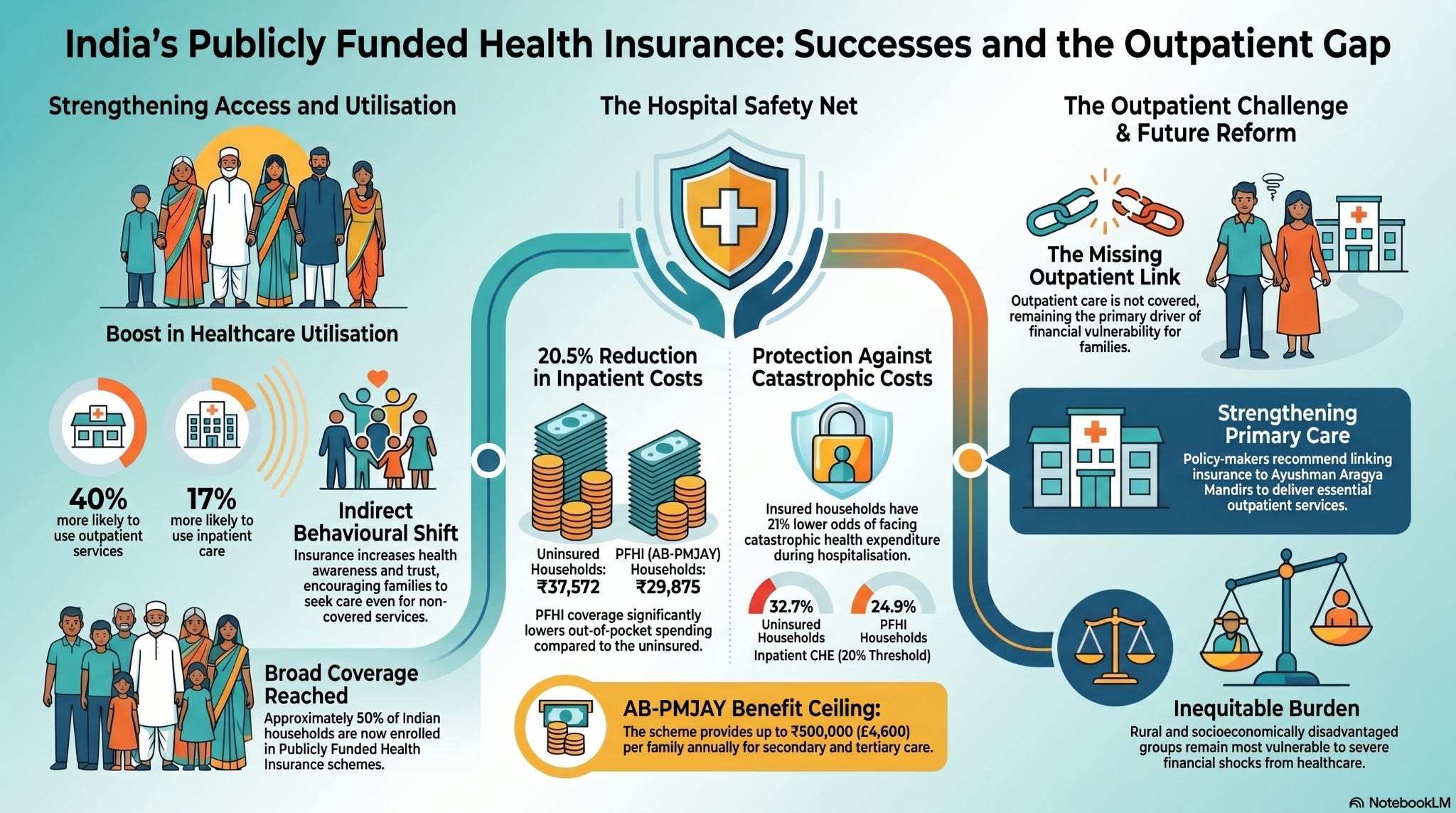
India’s massive AB-PMJAY health scheme has successfully protected millions from the crippling costs of hospital stays, but a major blind spot remains: it stops at the hospital gate. With out-of-pocket costs for daily check-ups and medicines continuing to drain household finances, a critical question emerges for the development sector. Discover how strategic corporate social responsibility (CSR) can step in to fund the next generation of primary healthcare models where the government cannot safely experiment.
The Status Quo Audit
The Cognitive Dissonance of the Social Impact Sector
For social development professionals, the workday doesn't really end at five - the mission becomes a lifestyle. Yet, there is a quiet, heavy friction in fighting systemic issues all morning only to return home and inevitably participate in the exact same structures you are trying to dismantle. Dive into this honest reflection on empathy fatigue, moral dilemmas, and how we can make the development world a place where the changemakers themselves can actually thrive.
NuSocia Pulse | Stories From the Ecosystem & Beyond

Stories from the Ground
Women and Work
“Despite the never-ending demands of household chores, many women find joy and purpose in creative work.”
- By Nisha Poojari, Project Manager at NuSocia
My field visits for primary research often take me to rural areas, and each time, I am moved by the remarkable resilience and dedication of the women I meet there. It is truly inspiring to witness how these women seamlessly balance multiple responsibilities within their households and communities. While urban women also shoulder numerous tasks with grace, there is something uniquely compelling about the way rural women navigate their varied roles.
One of the most heartwarming observations during my visit is their involvement in arts and crafts at home, in addition to their regular duties. Despite the never-ending demands of household chores, many women find joy and purpose in creative work, whether it’s sewing, embroidery, or other forms of craft. It seems that this artistic expression provides them with a brief respite from their fast-paced routines, offering a personal space to focus and create. Having grown up in a locality where women engage in embroidery, craft, and assembling work, I have also observed similar behaviour among urban women, who, whenever they have time, engage in such activities either out of passion or to earn extra income.
The photograph above is a perfect example of such involvement. It was captured during our visit to Bikaner for an impact assessment study. We were speaking with her daughter in the primary research. Her daughter, who volunteered for one of the client-led projects, helped us organize FGDs with other women in the community. Amidst all this, the woman in the photograph remained completely absorbed in her sewing, focused on completing her work despite the activity around her.
Ecosystem News
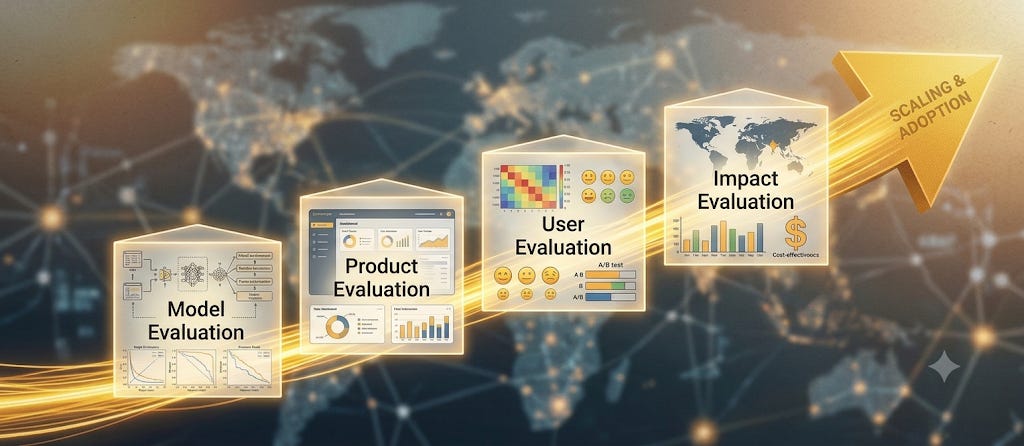
Exciting News for Evaluators with the Launch of the The AI Evaluation Playbook! https://eval.playbook.org.ai/ is a living, open-access resource co-developed by IDinsight, the Center for Global Development, and The Agency Fund. It features a rigorous, four-level framework explicitly designed to help social sector organizations audit and assess AI tools through the lens of real-world impact. Moving past purely technical metrics, the playbook systematically guides teams through evaluating AI models, product performance, user behavior change, and ultimately, high-stakes developmental outcomes.
How Evaluators Today Should Use It to Sharpen Their Skills:
Pivot to a “Risk-First” Entry Point: Traditional evaluation models are strictly linear. This playbook trains evaluators to identity and isolate the most pressing uncertainty or high-stakes risk in an AI deployment first, allowing them to deliver actionable insights when parts of an AI system are at vastly different stages of maturity.
Bridge the Gap Between Tech and Behavior: Evaluators can use the framework to stop treating product performance and user behavior as separate entities. It offers methodologies to track overlapping indicators such as whether a user trusts, follows, or corrects an AI recommendation, sharpening an evaluator’s ability to measure user experience and institutional readiness alongside code accuracy.
Master the Role of Domain-Expert Oversight: While automated “LLM-as-a-judge” tools are rising, the playbook emphasizes that they are rarely sufficient on their own for specialized sectors like medicine, law, or public welfare. Modern evaluators can look to this resource to learn how to responsibly blend automated evaluation with human expert feedback loops to ensure lasting safety and equity at the last mile.